


See what changes.
Preserve fine-grained actions and short-lived transitions instead of relying on sparse still frames.
Research release Generalist video MLLM
A generalist video MLLM built for fine-grained motion, long-form reasoning, temporal grounding, and live streaming.



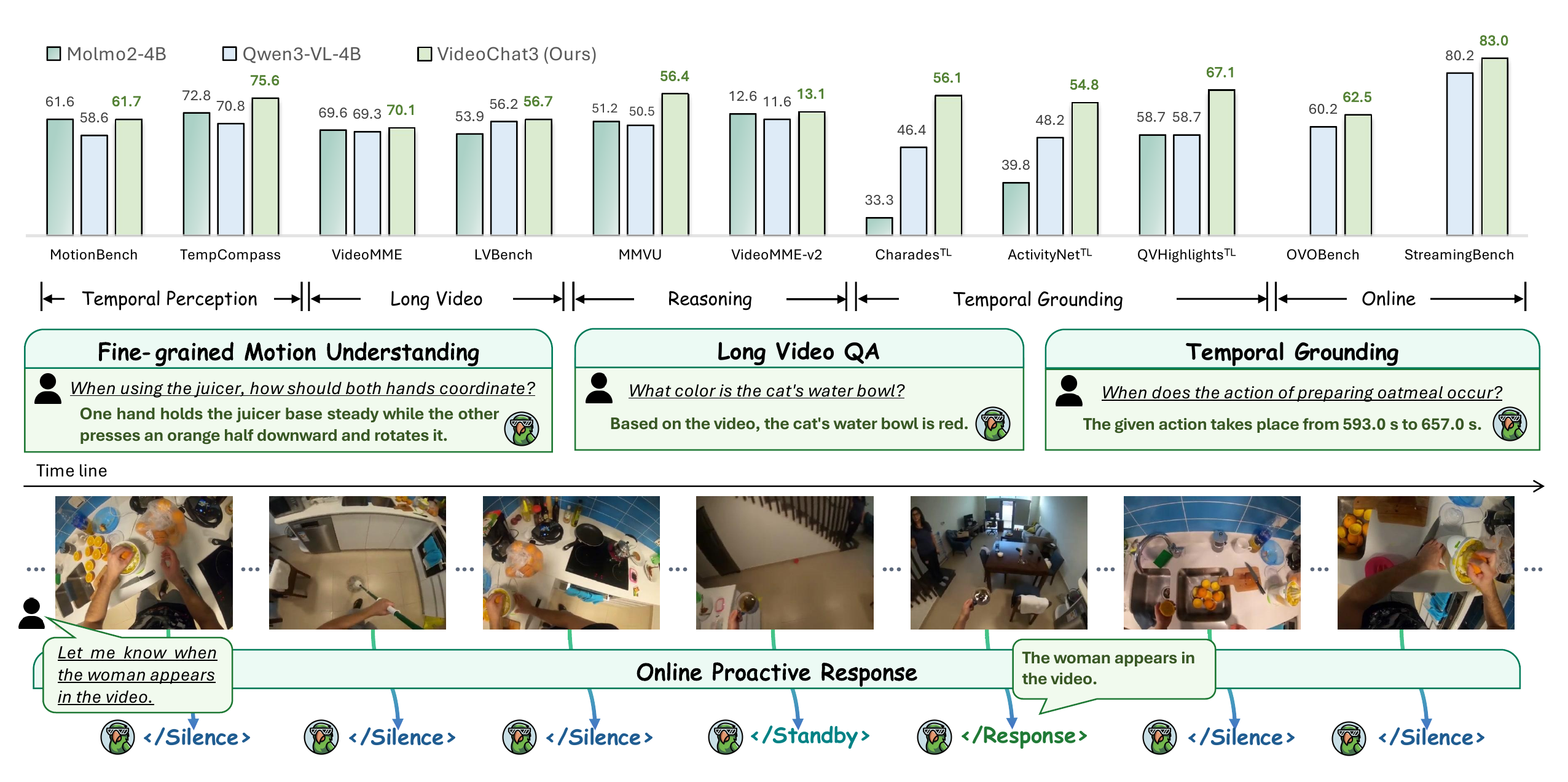
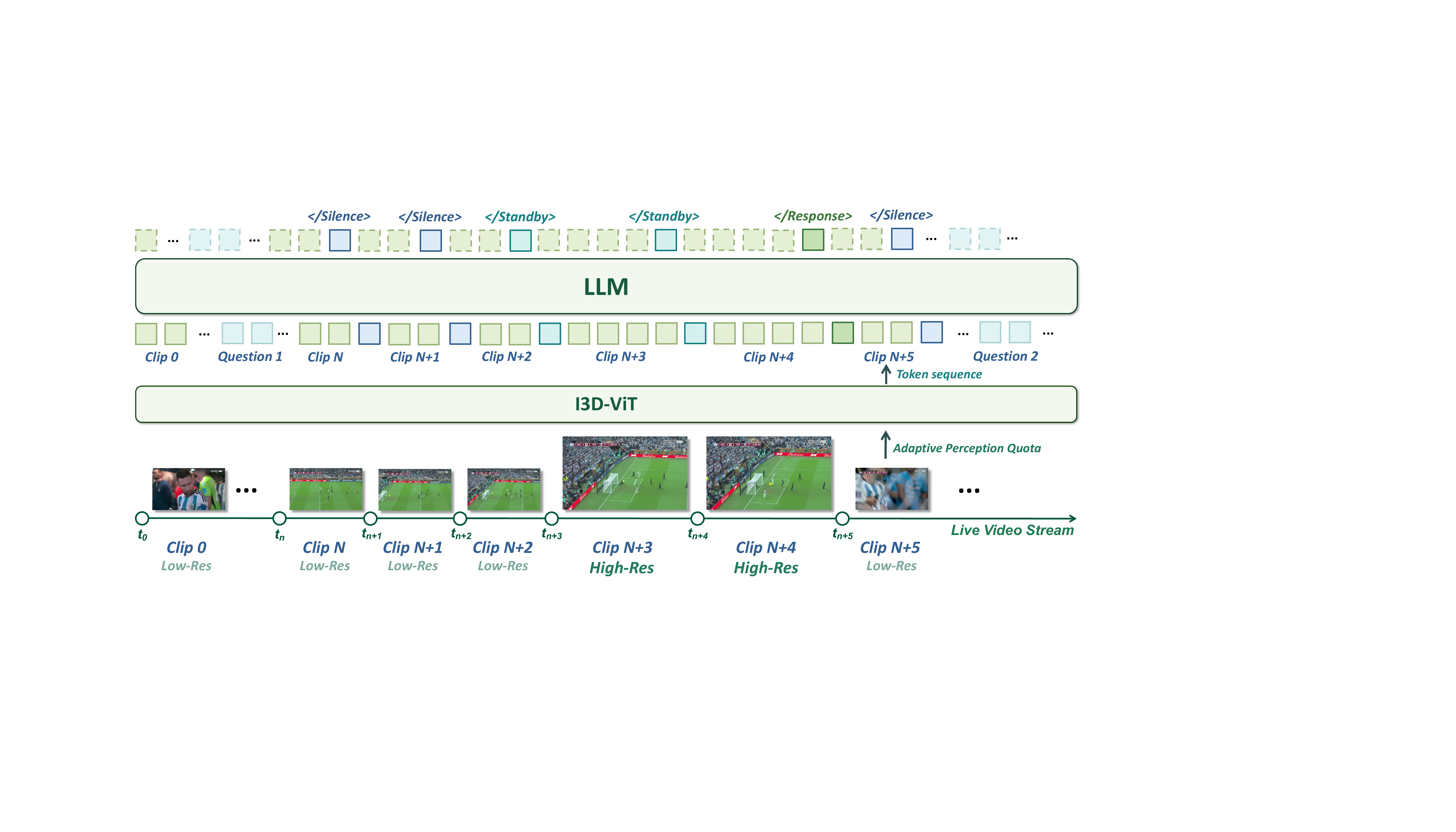
Standby alone switches the next window to high resolution; Response returns to low resolution.
THE PREMISE
Most video models are optimized for one regime. VideoChat3 treats video as a continuous temporal signal—from a subtle hand movement, to an hour-long story, to the moment a live assistant should respond.
Preserve fine-grained actions and short-lived transitions instead of relying on sparse still frames.
Connect evidence across minutes or hours, retrieve events, and ground answers to precise moments.
Observe causally, stay silent without enough evidence, and respond when the answer becomes available.
ARCHITECTURE / EFFICIENCY
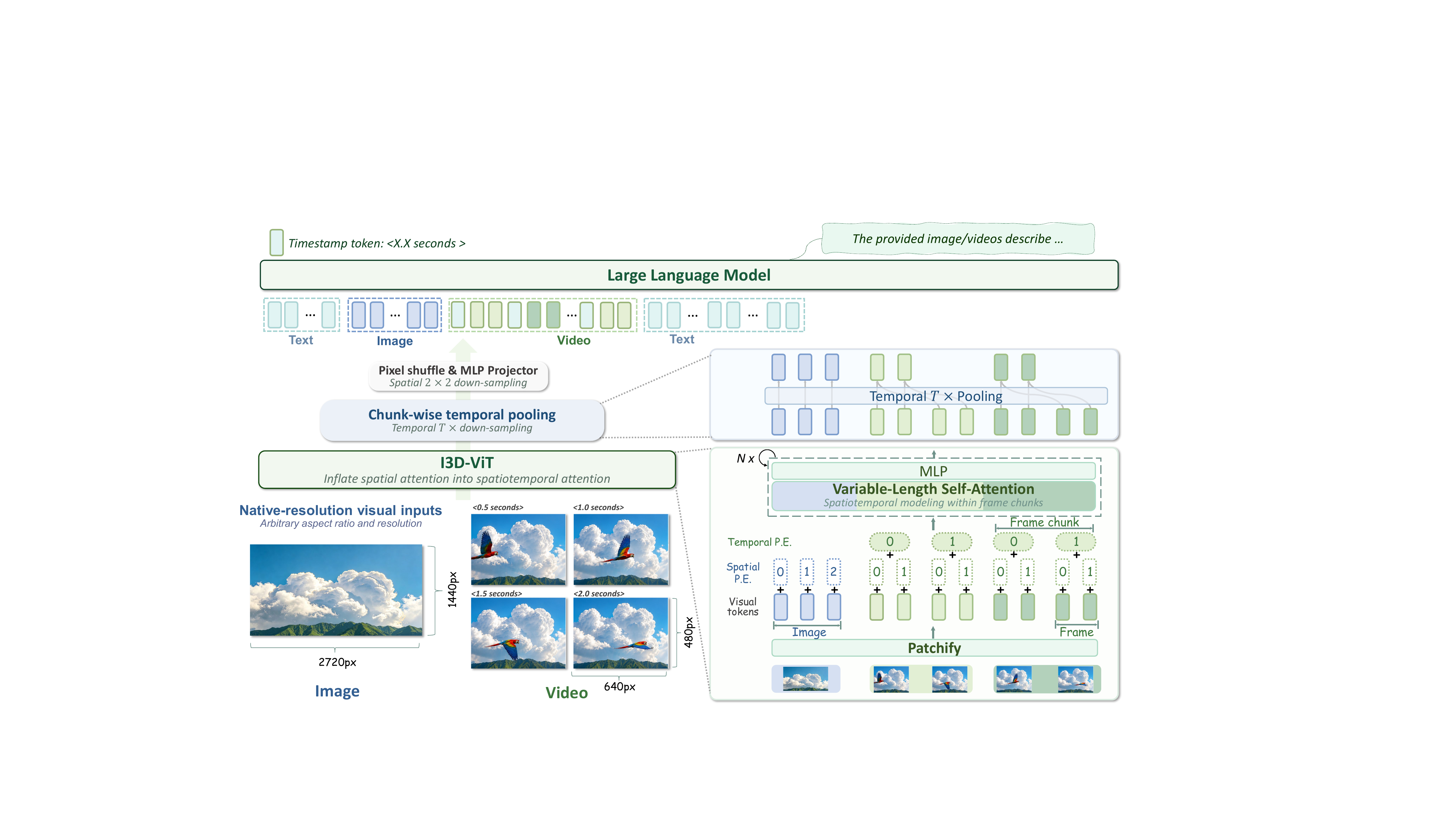
VideoChat3 models local space and time inside the visual tokenizer—before visual tokens reach the language model. Redundancy is removed early, while motion cues stay intact.
INFLATED 3D VISION TRANSFORMER
Groups four neighboring frames, performs native-resolution spatiotemporal attention, then pools in time.
ADAPTIVE FRAME RESOLUTION
Streaming windows start at low resolution. A Standby state raises the next window’s pixel budget to inspect emerging evidence.
DATA / EFFECTIVENESS
The data recipe moves from reliable academic labels to long-range evidence and causal response timing. Every stage is designed to make supervision denser without losing its grounding in the video.
Rewrites sparse labels into evidence-grounded answers, then filters for consistency with the original annotation.
Builds timestamped evidence ledgers for temporal grounding, event timelines, and cross-segment question answering.
Turns offline video QA into causal streams with explicit Silence, Standby, and Response supervision.
RESULTS
At 4B parameters, VideoChat3 improves on 18 of 19 directly comparable offline metrics and 10 of 11 streaming metrics against Qwen3‑VL‑4B under the paper’s evaluation settings.
+14.9 over Qwen3‑VL‑4B
+27.4 over Qwen3‑VL‑4B
I3D‑ViT shifts computation into a linear vision stage and halves the visual tokens that enter the quadratic language stage.
54% lower latency · 100,352 visual tokens · 80.8 GB
Results and efficiency figures are reported in the VideoChat3 paper. Benchmark protocols differ across suites.
QUALITATIVE DEMOS
Across dense description, long-video retrieval, temporal grounding, and proactive streaming, the same model turns changing visual evidence into grounded language.
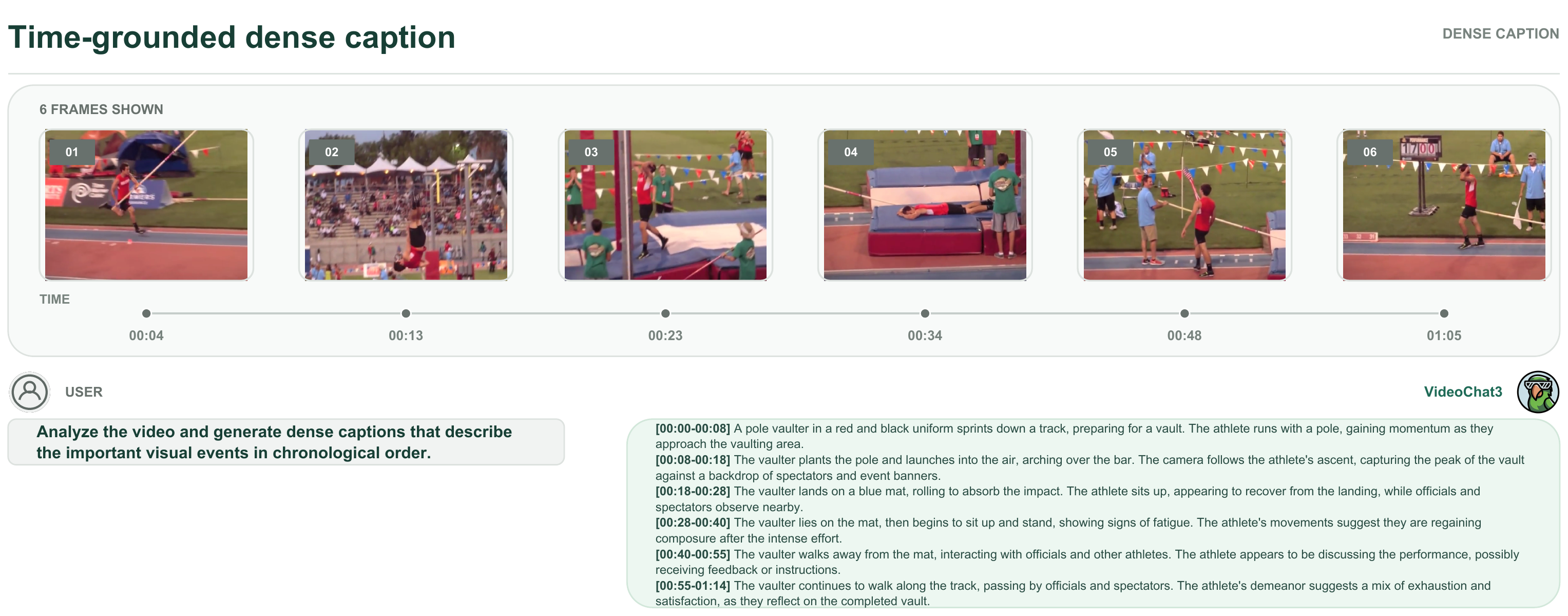
Describe evolving events with timestamps.
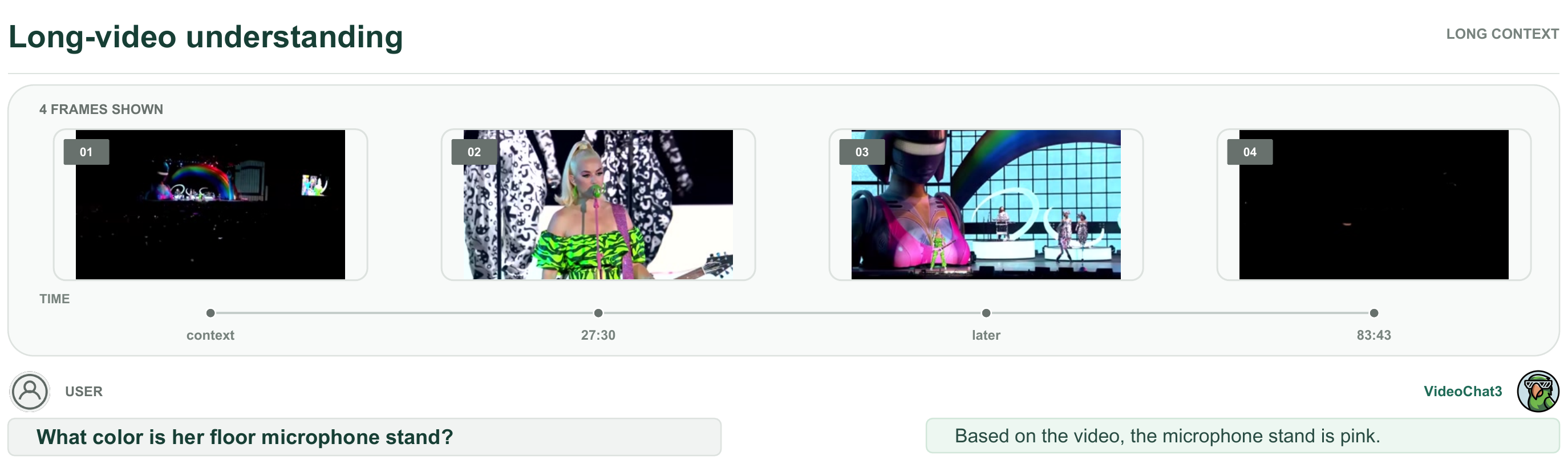
Retrieve details across extended context.
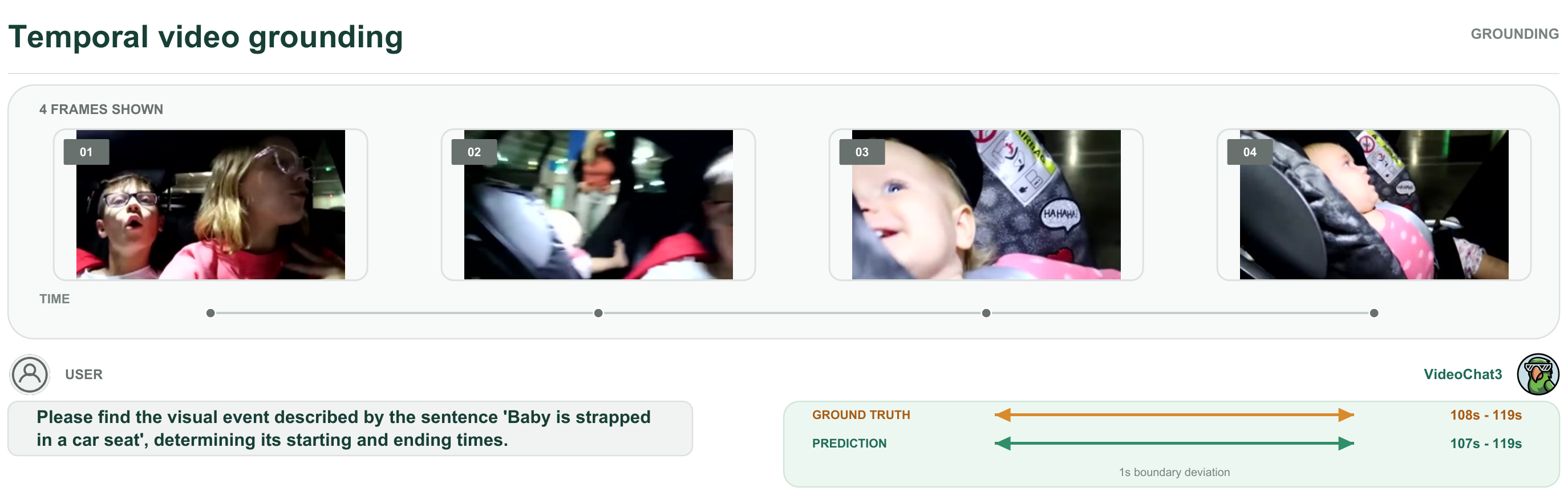
Map language to precise boundaries.
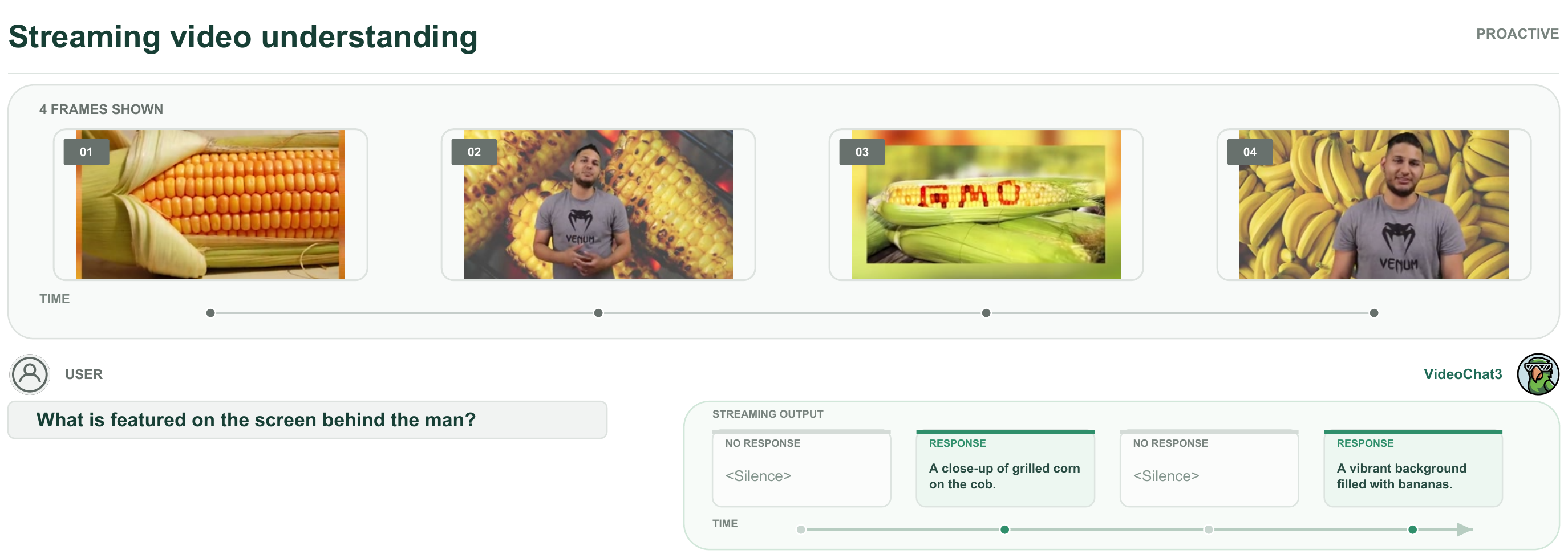
Observe, wait, then respond.
FULLY OPEN
VideoChat3 releases the pieces that turn a result into a research foundation: model weights, training code, training strategy, complete training datasets, and the data construction pipeline.