TimeLens2
Generalist Video Temporal Grounding with Multimodal LLMs
A unified 4B/8B temporal grounder that predicts variable-cardinality evidence sets across video lengths, domains, query forms, and viewpoints.
 Paper
Paper  Code
Code  Models & Data
 Overview
One interface for temporal evidence across heterogeneous video settings.
TimeLens2 represents temporal evidence as an interval set throughout supervision and optimization. The same generative interface handles single-span, multi-span, question-form, long-video, and egocentric grounding.
TimeLens2-93K
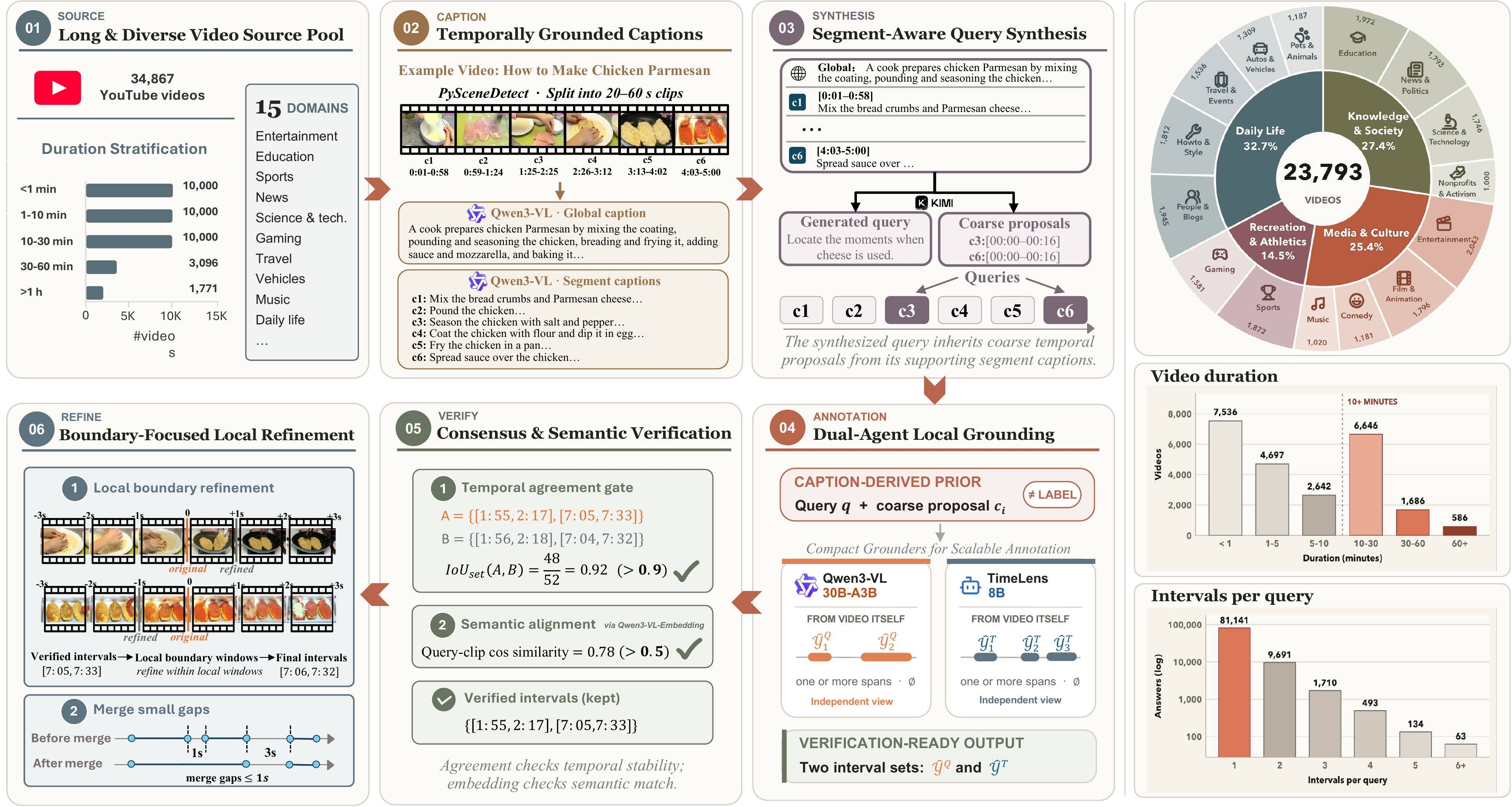
Turn long-video annotation into a sequence of verifiable decisions.
Caption-derived proposals narrow the search space; independent local grounding, temporal consensus, semantic checks, and boundary refinement determine the final interval sets.
Method
Align training with the structure of temporal evidence.
Sparse, variable-cardinality intervals require supervision and objectives that preserve their set-level geometry.
Verified supervision
Caption-derived proposals are independently localized, checked by cross-agent consensus, semantically verified, and boundary-refined.
Long-context generalist
TimeLens2-93K and contexts up to 100K tokens teach one 4B or 8B model to retain sparse evidence through distractor-heavy videos.
Temporal Wasserstein reward
Exact one-dimensional W₁ over merged interval support complements tIoU with dense, matching-free credit for near and distant errors.
RTW = exp(−W₁ / (|merge(Y)| + ε))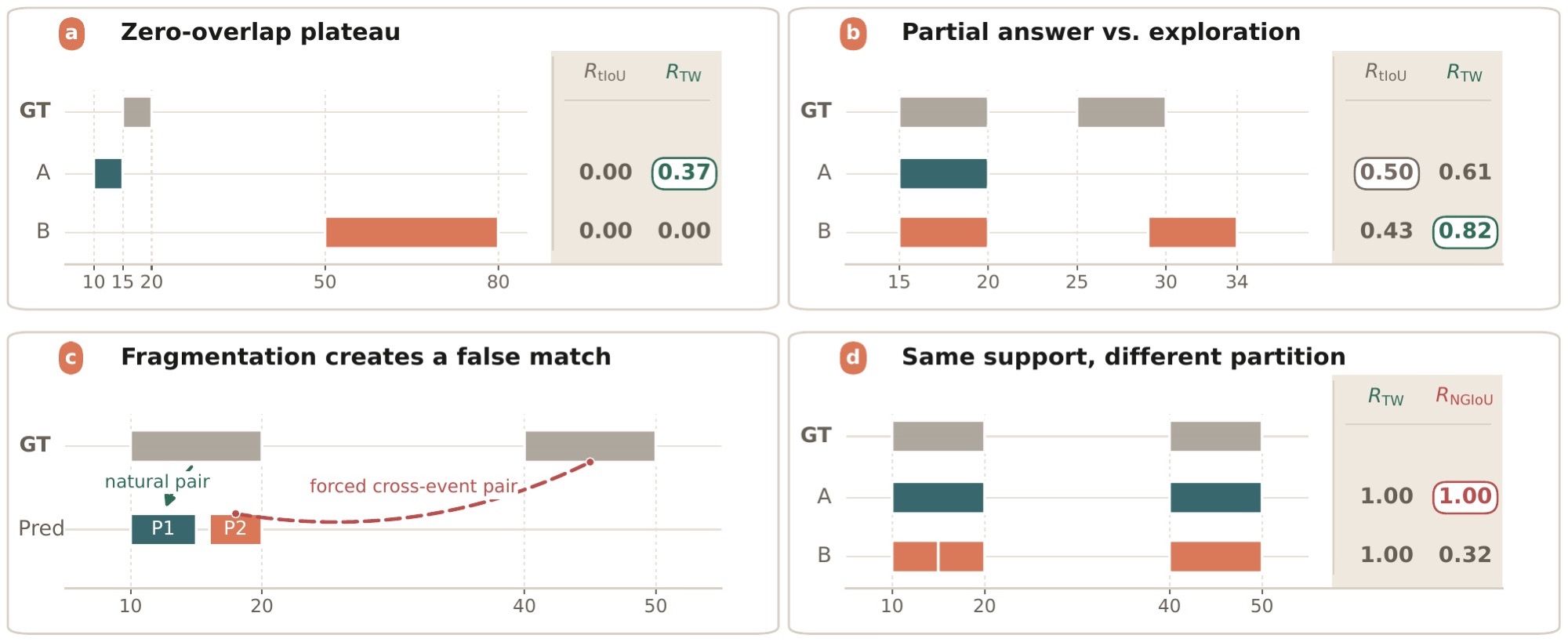
Results
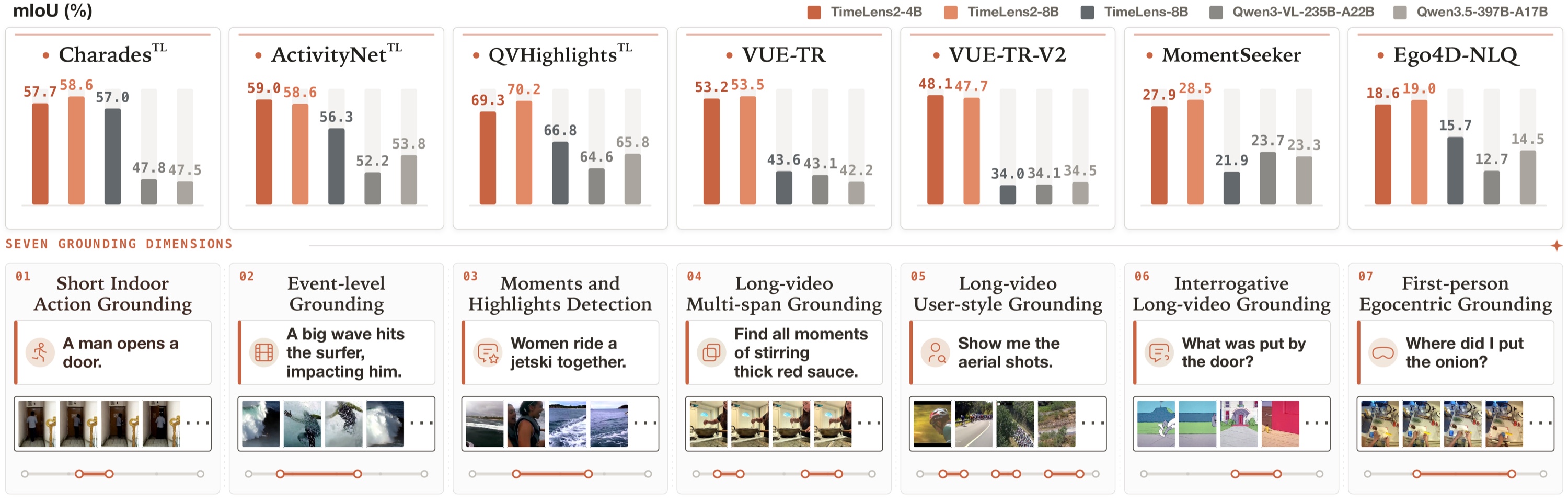
Compact models with broad temporal range.
TimeLens2-4B TimeLens2-8B Qwen3-VL-235B-A22B Qwen3.5-397B-A17B
CharadesShort action
ActivityNetEvent-level
QVHighlightsHighlight
VUE-TRLong / multi
VUE-TR-V2Long / user
MomentSeekerQuestion-form
Ego4D-NLQEgocentric
Qualitative analysis
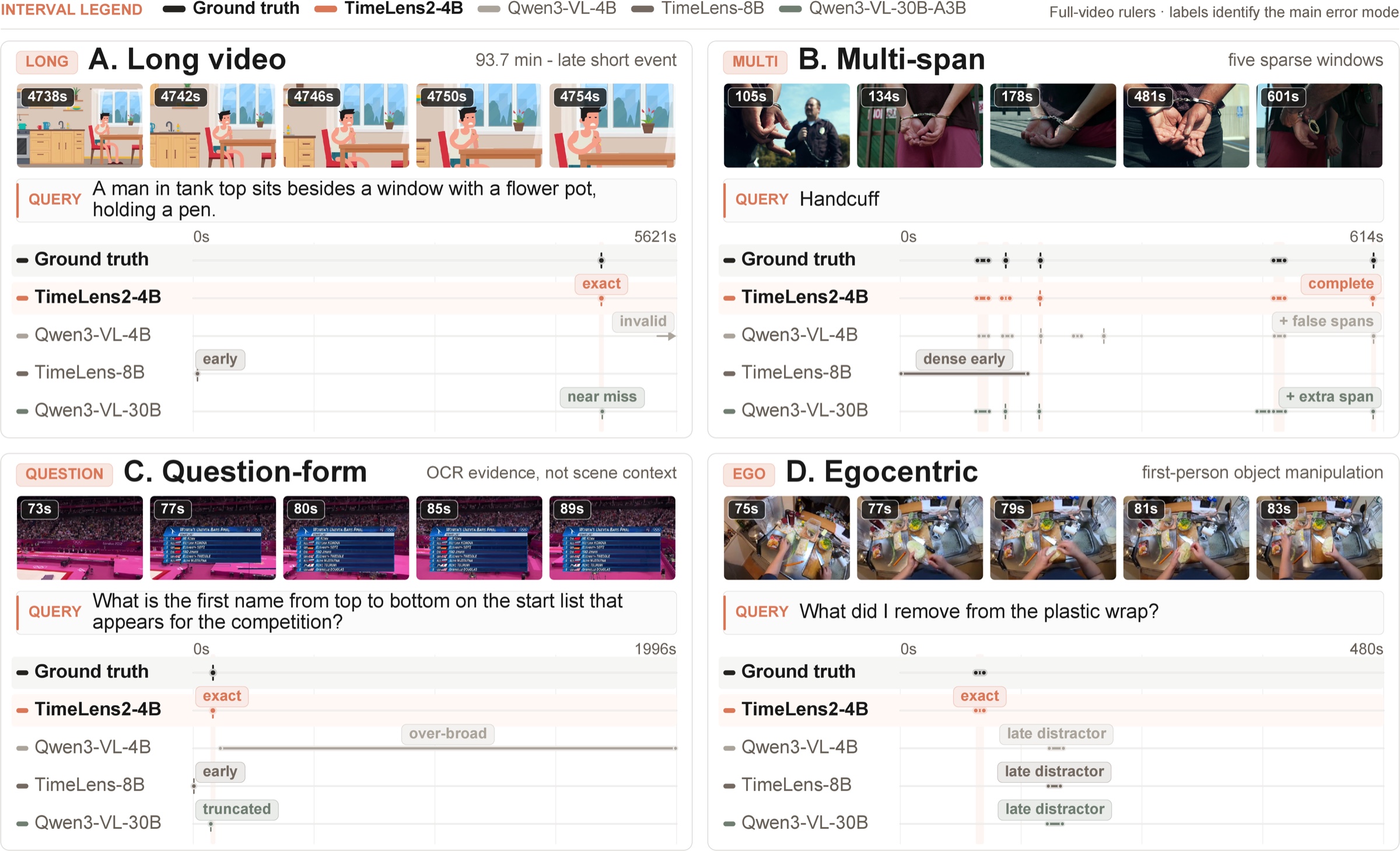
The right event, not merely a plausible scene.
The model remains calibrated on long videos, preserves multiple sparse moments, grounds OCR evidence, and rejects visually similar distractors.
Supplementary examples
Seven benchmarks, seven temporal reasoning challenges.
Additional cases isolate state transitions, conjunctive events, role binding, repeated evidence, sparse long-range relations, anomaly semantics, and first-person preconditions.